
Atlas of Amphibians and Reptiles in Europe
Mapping Europe’s Herpetological Diversity
Understanding where amphibians and reptiles occur is fundamental to protecting Europe’s biodiversity. Accurate distribution data provide the scientific foundation for conservation planning, habitat management, environmental assessments, and understanding how species respond to climate change and other environmental pressures.
The SEH Mapping Committee has played a leading role in documenting the distribution of European amphibians and reptiles for decades. Following the publication of the landmark Atlas of Amphibians and Reptiles in Europe by Gasc et al. in 1997, the Committee coordinated an extensive international effort to update and expand our knowledge of European herpetofauna.
A New Generation of Distribution Maps
In 2014, the SEH Mapping Committee published the New Atlas of Amphibians and Reptiles in Europe (NA2RE), bringing together more than 384,000 distribution records from 40 European countries.
This collaborative achievement incorporated advances in taxonomy, new field observations, and national and regional mapping initiatives to provide a more comprehensive picture of Europe’s amphibian and reptile diversity.
The resulting dataset has helped identify important geographical and taxonomic knowledge gaps, highlight priorities for future research, and support conservation efforts across national borders.
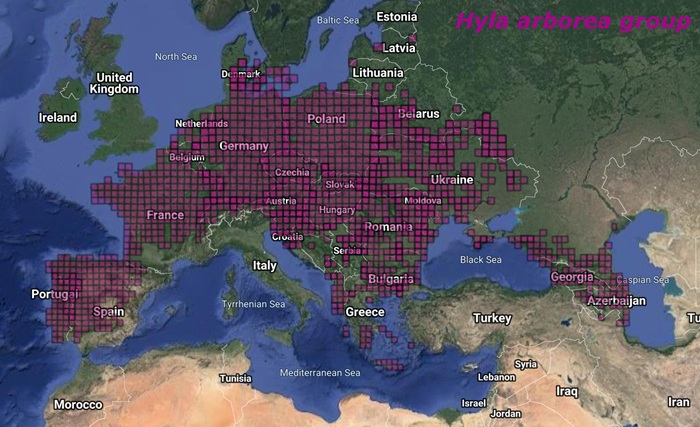
Explore the European Herpetofauna Atlas
The atlas provides open-access distribution maps for European amphibian and reptile species, together with downloadable GIS shapefiles for research, spatial analysis, and conservation planning.
Scientific Publication
Sillero, N., Campos, J., Bonardi, A., Corti, C., Creemers, R., Crochet, P.-A., Crnobrnja Isailović, J., Denoël, M., Ficetola, G. F., Gonçalves, J., Kuzmin, S., Lymberakis, P., de Pous, P., Rodríguez, A., Sindaco, R., Speybroeck, J., Toxopeus, B., Vieites, D. R. & Vences, M. (2014).
Updated distribution and biogeography of amphibians and reptiles of Europe. Amphibia-Reptilia, 35: 1–31.
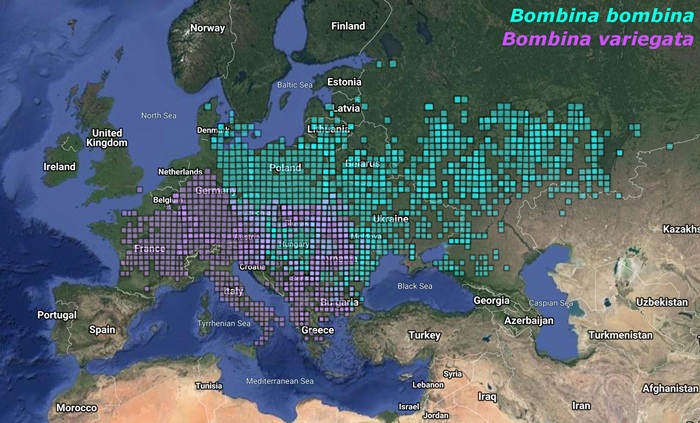
Towards a More Connected Future
The European Herpetofauna Atlas demonstrates the power of international scientific collaboration. As biodiversity faces increasing pressure from habitat loss, fragmentation, and climate change, coordinated distribution mapping remains essential for identifying conservation priorities and understanding changes in species ranges.
Through its Mapping Committee and cooperation with national herpetological societies, SEH aims to encourage continued data sharing, improve geographical coverage, and support the development of accessible, scientifically robust distribution information for Europe’s amphibians and reptiles.
