
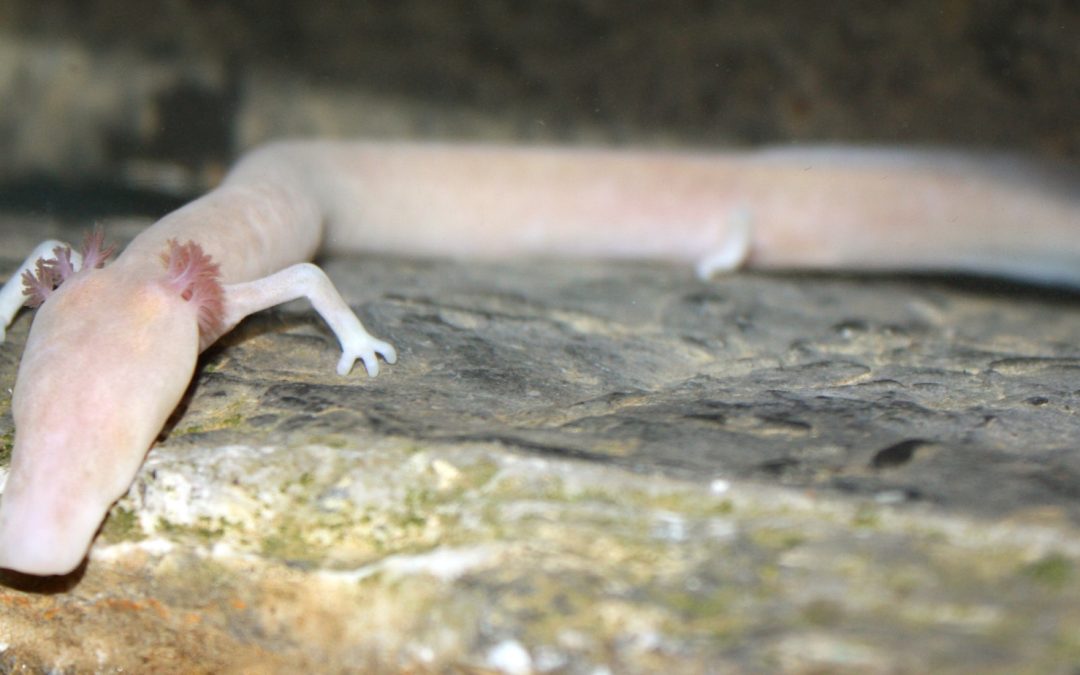
The olm (Proteus anguinus) is a blind, depigmented salamander that lives exclusively in the underground waters of the Dinaric Karst mountains of Bosnia and Herzegovina, Croatia, Italy and Slovenia. Conducted by an international team led by the SEH Taxonomic Committee, a new study published in Amphibia-Reptilia revisits the evolution and diversity of this legendary animal and recognizes nine distinct species, some with extremely restricted distributions that rank among the most threatened vertebrates in Europe.
Dubbed “human fish” for his white, slender body and delicate limbs, the olm is one of the world’s most iconic cave-dwelling animals. Resident of the cold subterranean rivers and lakes beneath the Dinaric mountains, it is the world’s longest-lived amphibian, with some specimens exceeding a century in age.
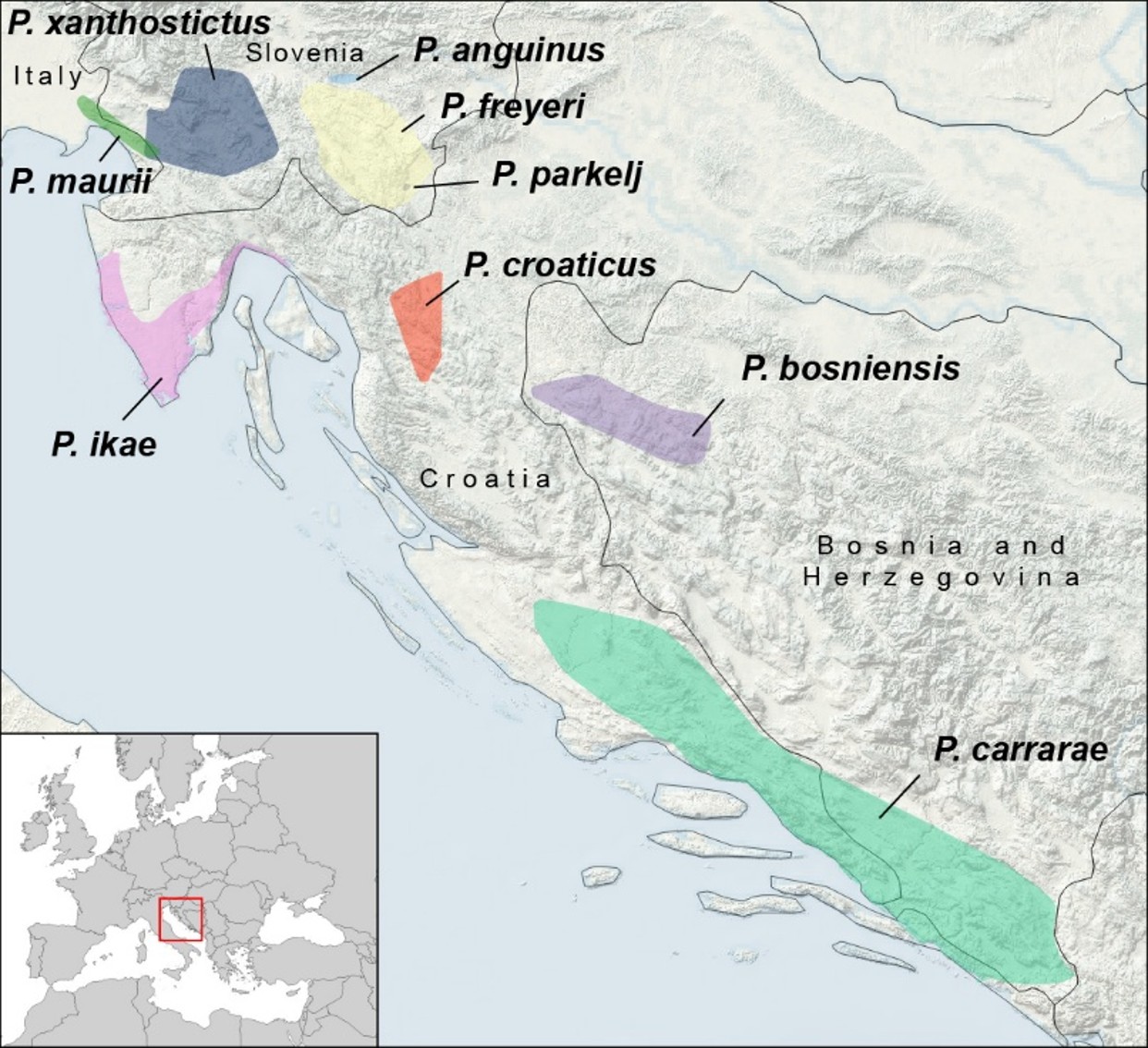
Distribution and scientific names of the nine species of olms newly recognized
Yet, despite 350 years of scientific research and cues for distinctions between populations, the olm has been regarded as a single species, Proteus anguinus – with only a surface-adapted dark form found in one Slovenian karst spring being distinguished as a subspecies, P. a. parkelj.
By reviewing and re-assessing the evolution, genetic diversity, morphological variation, geographic distributions and habitat characteristics of Proteus, combined with an investigation of its complex taxonomic history, the study substantiated that the olm comprises nine distinct species, including three newly described to science. These findings rank Proteus as one of the most remarkable amphibian diversifications in Europe, but also one of the most threatened: all species have narrow distribution ranges, some being restricted to single groundwater systems, placing them at immediate risk of extinction.
For decades, one of the major unresolved questions in European herpetology has been the true diversity of the olm (Proteus), Europe’s iconic cave salamander. Growing genetic evidence suggested that what was considered a single species was in fact a complex of deeply divergent evolutionary lineages. Recognizing both the scientific and conservation importance of resolving this question, the Societas Europaea Herpetologica (SEH), through members of its Taxonomic Committee, took the lead in bringing together an international team of experts to reassess the taxonomy of Proteus. The resulting study recognizes nine distinct species, including three newly described to science.
Resolving their taxonomy also provides the foundation for something even more important: recognizing and protecting the true diversity of Europe’s cave dragons, several of which are restricted to very small groundwater systems and face an immediate risk of extinction.
“People often forget that it was not always considered a single species,” says Dr. Daniel Jablonski, researcher at Comenius University in Bratislava and associate at the Natural History Museum Vienna, who co-led the study. “In the mid-nineteenth century, the Austrian zoologist Leopold Fitzinger described seven species of olm. But because their differences were subtle, later researchers synonymized them all into a single species.”
During the last three decades, molecular biology has completely transformed this picture.
“Olms from different geographic regions and groundwater systems differ genetically as much as many well-established amphibian species,” explains Dr. Christophe Dufresnes, curator of Amphibians at the Muséum national d’Histoire naturelle in Paris and first author of the study. “As more populations were sampled and increasingly powerful genetic tools became available, it became clear that we were dealing with an ancient diversification rather than a single species.”
From these studies, nine evolutionary lineages diverged between approximately 16 and 4 million years ago were eventually identified, and the researchers concluded that each represents a distinct species.
By combining published genetic information with occurrence records collected over centuries, the team was able not only to map the distribution of each species but also to predict where undiscovered populations might occur.
“We developed the first species distribution models ever produced for the genus Proteus,” says Benjamin Monod-Broca, PhD student at Université Claude Bernard Lyon 1 and co-author of the study. “These models highlight several poorly explored karst regions that appear environmentally suitable, particularly in northern Albania.”
These unexplored areas may still conceal previously unknown populations – and perhaps even more species – hidden beneath the Dinaric Karst.
Searching for new olms has become something of an obsession for co-author Dr. Dušan Jelić, researcher at the Croatian Institute for Biodiversity, who has been cave diving throughout the Karst for nearly twenty years.
“This is by far the most challenging amphibian to study in Europe,” he says. “Species inhabit complex networks of flooded caves where the water rarely exceeds 10°C, sometimes hundreds of meters below ground. Fortunately, we can now also detect them through environmental DNA by analyzing simple water samples.”

Finding olms involes deep cave exploration, and often requires speleo-diving (© Christophe Dufresnes)
Accurate distribution data provided by these monitoring techniques are essential for conservation. By applying the revised taxonomy to their occurrence dataset, the authors estimated the conservation status of each species according to IUCN Red List criteria.
“All species are threatened, but two of them are facing immediate danger of extinction,” warns Jelić. “They are confined to a single groundwater system, meaning that, in principle, a single major pollution event could wipe out them out entirely.”
Another long-standing question since Fitzinger’s time was whether these newly recognized species could actually be distinguished morphologically.
To answer it, Dufresnes and Jablonski reexamined hundreds of preserved specimens housed in natural history museums across Europe, including several of Fitzinger’s original specimens preserved in Vienna.
“We found many subtle but statistically significant differences, particularly among the oldest evolutionary lineages,” says Jablonski. “Morphological divergence appears to have accumulated gradually through time. Even so, most species remain remarkably similar externally, which explains why they escaped recognition for so long.”
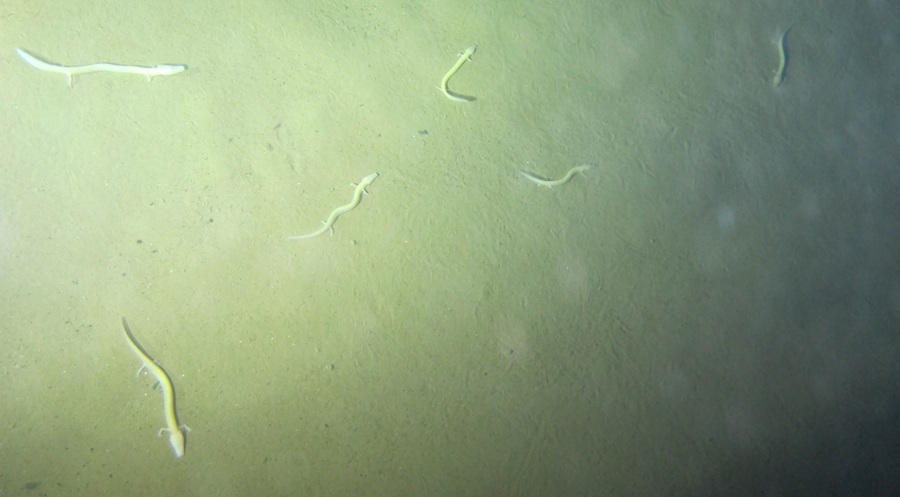
Population of Proteus croaticus in its natural habitat. © Dušan Jelić
Perhaps the most important outcome of the study is that this hidden diversity can now be formally recognized.
“Species need scientific names before they can receive legal protection,” says Dufresnes. “Recognizing these lineages as distinct species provides the framework needed for targeted conservation measures, ecological studies and future monitoring.”
Naming the species, however, required solving nearly two centuries and a half of taxonomic confusion.
“Twelve scientific names had already been proposed for olms, most of them during the first half of the nineteenth century,” explains Prof. Annemarie Ohler, curator of Amphibians at the Muséum national d’Histoire naturelle and an internationally recognized specialist in zoological nomenclature. “Our challenge was to determine which historical name belonged to which modern species – a true detective investigation through centuries of scientific literature.”
In the end, six species could retain historical names, while the remaining three required formal description as new species.
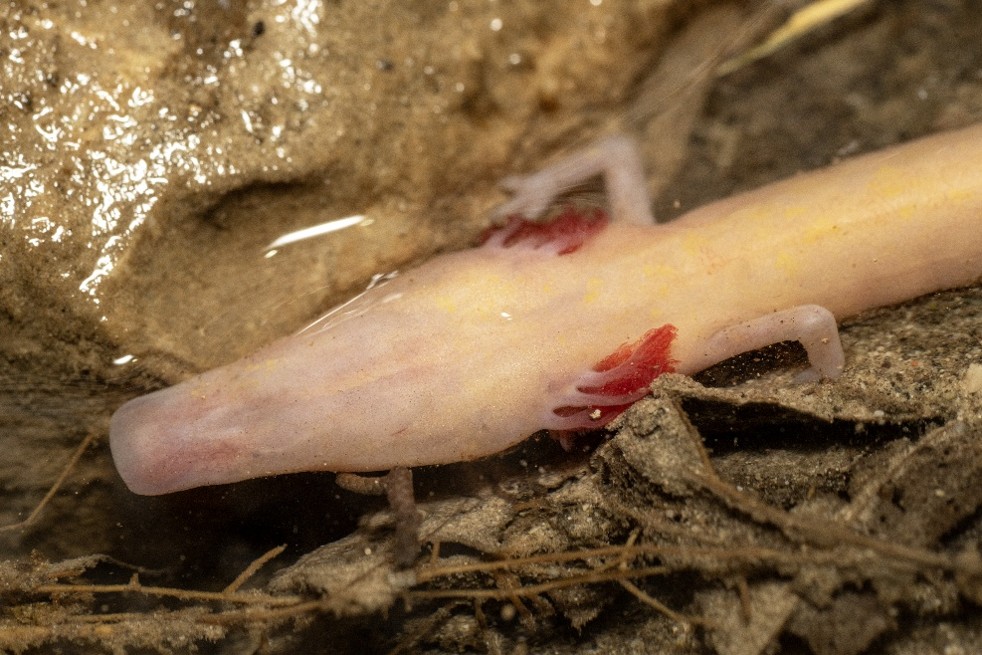
One of these, Proteus maurii, is restricted to the Italian Karst.
“Unlike most other species, the Italian olm is regularly observed in open karst springs,” explain Dr. Raoul Manenti and Dr. Benedetta Barzaghi, researchers at the University of Milan and co-authors of the study. “This challenges the traditional view that olms are strictly subterranean animals.”
Proteus maurii is named in honor of the Italian naturalist Edgardo Mauri, who devoted much of his life to studying olms. © Daniel Jablonski
Another newly described species, Proteus bosniensis, was only confirmed from a few localities in Bosnia and Herzegovina.
“It is the only amphibian species endemic to our country,” says Dr. Emina Šunje, researcher at the University of Sarajevo and co-author. “Given the extent of underground karst rivers in Bosnia, it may well prove more widespread than we currently know.”
The third new species, Proteus ikae, takes its name from an ancient Istrian deity.
“This is the earliest-diverging living species of olm,” says Jelić. “Its unusually elongated head and body may reflect adaptation to the deeper cave systems of Istria [north–western Croatia].”
For Jablonski, P. ikae carries special personal significance.
“I first saw this species in a show cave when I was ten years old,” he recalls. “I still remember how fascinated I was. Looking back, that encounter undoubtedly played a role in my decision to become a zoologist.”
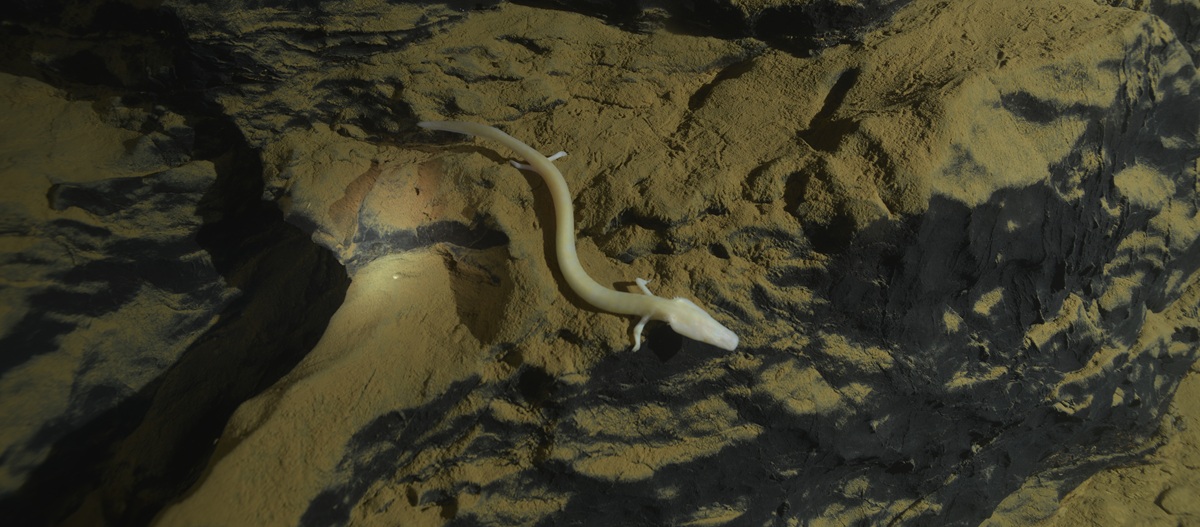
Proteus ikae has been evolving independently for 16 million years. © Dušan Jelić
And what about Fitzinger’s seven species?
History has given the Austrian zoologist a partial vindication. Four of his names proved to either refer to the same species or to the original Proteus anguinus, and therefore remain synonyms. But three have now been resurrected after 176 years.
“It is deeply satisfying to see these forgotten names restored,” concludes Dufresnes. “They were coined during what was arguably the golden age of olm exploration, and today they once again have their rightful place in zoology.”
Reference: Dufresnes C, Monod-Broca B, Jelić D, Šunje E, Manenti R, Barzaghi B, Zimić A, Chouchane K, Denoël M, Ohler A, Jablonski D. 2026. Olm Sweet Olm: Unearthing nine species of Proteus hidden beneath the Dinaric Karst. Amphibia–Reptilia. In Press.